Future of Cosmetic Surgery: AI, Robotics, and Precision Techniques
Cosmetic surgery is changing very quickly. In the past, it depended mostly on a surgeon’s skill and experience. However, today it is becoming more advanced due to technology. In particular, artificial intelligence (AI), robotics, and precision-based tools are transforming how treatments are planned and performed.
As a result, cosmetic surgery is now more accurate, safer, and more personalized. Moreover, patients are getting better results with less pain and faster recovery. Therefore, understanding these changes is important for anyone interested in modern aesthetic medicine.
From Traditional Methods to Modern Technology
Earlier, cosmetic surgery was mainly an art. Surgeons used their hands, experience, and judgment to improve appearance. While this approach still matters, it had some limitations. For example, results could vary from one surgeon to another, and predicting outcomes was not always easy.
However, things are different today. With the help of digital tools, surgery is now more scientific. In addition, doctors can use advanced software to plan procedures before actually performing them.
For instance:
- 3D facial scanning helps study facial structure
- Computer software simulates surgical results
- Digital imaging improves planning accuracy
Because of these tools, surgeons can make better decisions and reduce risks. Consequently, patients receive more consistent and natural-looking results.
Growing Role of Artificial Intelligence (AI)
Artificial intelligence is becoming a powerful support system in cosmetic surgery. In fact, it is changing the way doctors understand and treat patients.
AI in Patient Analysis
Firstly, AI can analyze facial features in detail. It studies symmetry, proportions, and skin condition. Then, it provides suggestions for improvement.
As a result:
- Doctors get clearer insights
- Treatment becomes more personalized
- Planning becomes faster and more accurate
Moreover, AI reduces human error during the analysis stage.
AI for Predicting Results
Another important use of AI is prediction. Before surgery, patients can see a digital version of their expected results. This is very helpful because it sets realistic expectations.
For example:
- A patient can see a simulated nose shape after rhinoplasty
- A facelift outcome can be previewed digitally
- Body contour changes can be visualized in advance
Therefore, patients feel more confident and informed before making decisions.
AI Improving Decision-Making
In addition, AI systems learn from thousands of past surgeries. Because of this, they can identify what works best in different cases. Over time, this helps doctors choose safer and more effective treatment methods.
Thus, AI is not replacing doctors; instead, it is supporting them in making better choices.
Consult experts for personalized aesthetic transformation now
Robotics: Precision Beyond Human Hands
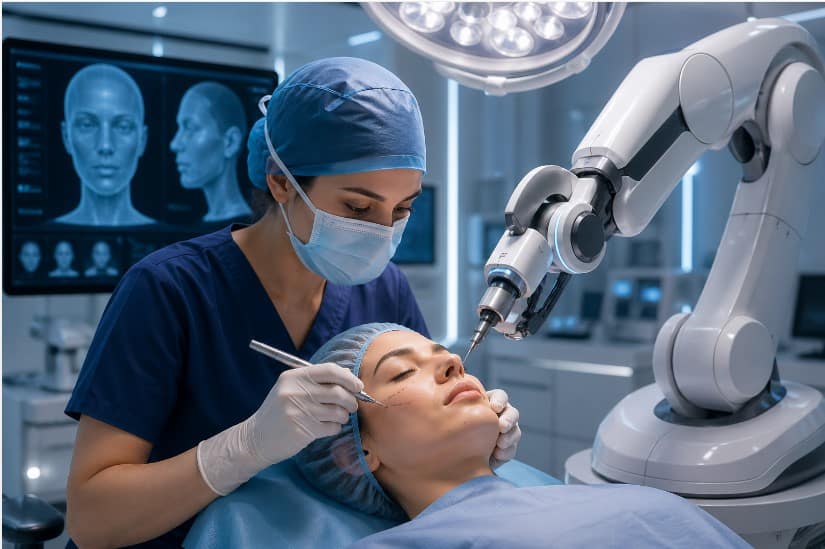
Robotics is another major development in cosmetic surgery. While surgeons remain in control, robotic systems assist them with extreme precision.
Why Robotics Matters
Human hands are skilled, but they can have small natural movements. On the other hand, robotic systems are steady and highly accurate. Therefore, they help perform delicate procedures with better control.
As a result:
- Movements become more precise
- Surgical errors reduce
- Healing becomes faster
Minimally Invasive Procedures
Furthermore, robotics allows surgeons to perform operations using smaller cuts. This is known as minimally invasive surgery.
Because of this:
- Scarring is reduced
- Pain is lower
- Recovery time is shorter
In many cases, patients can return to normal life much sooner than before.
Better Control and Visibility
Robotic systems also provide enhanced 3D visualization. In other words, surgeons can see the surgical area more clearly and in greater detail.
Therefore, even complex procedures become safer and more controlled.
Precision Techniques: The New Standard
Along with AI and robotics, precision techniques are improving cosmetic surgery outcomes. These methods focus on accuracy and customization.
3D Imaging Technology
Firstly, 3D imaging plays a key role. It creates a detailed digital model of the patient’s face or body. As a result, surgeons can plan every step before surgery begins.
This leads to:
- Better accuracy
- Fewer surprises during surgery
- Improved patient satisfaction
Laser-Based Treatments
Secondly, laser technology is widely used in skin treatments. It helps in:
- Reducing scars
- Improving skin texture
- Removing unwanted hair
In addition, lasers are less invasive compared to traditional methods. Therefore, healing is faster and more comfortable.
Image-Guided Surgery
Finally, image-guided systems help surgeons see internal structures in real time. Consequently, they can perform procedures with higher safety and precision.
Why These Changes Matter
Overall, the combination of AI, robotics, and precision tools is improving cosmetic surgery in many ways. Not only are results more natural, but procedures are also becoming safer and more predictable.
In summary:
- AI improves planning and prediction
- Robotics increases surgical accuracy
- Precision tools enhance safety and outcomes
Together, these technologies are shaping the future of cosmetic surgery.
Schedule your cosmetic surgery consultation with specialists
Advanced AI Applications in Cosmetic Surgery
Artificial intelligence is not only used for basic analysis anymore. In fact, it is now deeply involved in planning, monitoring, and improving cosmetic procedures.
AI in Surgical Planning
Firstly, AI helps surgeons create highly detailed surgical plans. It studies facial structure, body proportions, and previous medical records. Then, it suggests the most suitable approach for each patient.
Because of this, doctors can:
- Choose safer surgical techniques
- Reduce unnecessary procedures
- Customize treatments more effectively
Moreover, AI reduces guesswork. Instead of relying only on experience, surgeons now use data-driven insights.
AI-Based Risk Assessment
In addition, AI is very useful in predicting possible risks before surgery. It can analyze a patient’s health condition and identify potential complications.
For example, AI can detect:
- Slow healing tendencies
- Allergic reactions to anesthesia
- Higher infection risks
- Blood circulation issues
As a result, surgeons can take preventive steps in advance. Therefore, the overall safety of cosmetic surgery is improving significantly.
Smart Monitoring During Surgery
Another important development is real-time AI monitoring. During surgery, AI systems track vital signs and surgical progress continuously.
This helps in:
- Immediate detection of irregularities
- Better control of surgical precision
- Reducing human error during complex procedures
Furthermore, it supports surgeons by providing instant feedback, which improves decision-making during critical moments.
Robotics: Transforming Surgical Accuracy
Robotics is becoming one of the most important tools in modern cosmetic surgery. Although surgeons still perform the operation, robotic systems assist in making every movement more accurate.
Robotic Assistance in Complex Procedures
Robotic systems are especially useful in delicate facial surgeries. For instance, in rhinoplasty or eyelid surgery, even a small error can affect results. Therefore, robotic assistance ensures high precision.
Because of this technology:
- Movements become extremely stable
- Fine adjustments are more controlled
- Tissue damage is minimized
In addition, robotic tools help reduce fatigue, especially during long surgeries.
Enhanced 3D Surgical Vision
Moreover, robotic systems provide advanced 3D visualization. Surgeons can see tissues, muscles, and structures in high detail.
This leads to:
- Better depth perception
- Improved accuracy in small areas
- Safer surgical decisions
As a result, even complex cosmetic procedures become more controlled and predictable.
Minimally Invasive Robotic Techniques
Another major advantage of robotics is minimally invasive surgery. Instead of large cuts, surgeons can use small entry points.
Therefore:
- Scarring is significantly reduced
- Pain after surgery is lower
- Recovery time becomes shorter
In many cases, patients can resume normal activities much faster than before.
Precision Techniques Improving Outcomes
Precision is becoming the foundation of modern cosmetic surgery. Along with AI and robotics, advanced techniques are making procedures more refined and customized.
Digital 3D Surgical Simulation
Firstly, 3D simulation technology allows surgeons to create a virtual model of the expected result. This is extremely helpful for both doctors and patients.
Because of this technology:
- Patients can preview outcomes before surgery
- Surgeons can plan each step more accurately
- Expectations become more realistic
In addition, this reduces dissatisfaction after surgery, since patients already understand possible results.
Laser and Energy-Based Procedures
Secondly, laser technology continues to play a major role in cosmetic treatments. It is widely used for skin improvement, scar reduction, and anti-aging procedures.
Laser treatments offer several benefits:
- Less bleeding during procedures
- Faster healing of skin
- More controlled treatment depth
Similarly, energy-based devices such as ultrasound and radiofrequency are used for skin tightening and fat reduction without surgery.
Personalized Treatment Mapping
Another important development is personalized treatment mapping. Every person has different facial structure and skin behavior. Therefore, cosmetic surgery is now designed individually.
With precision mapping:
- Treatments are fully customized
- Natural appearance is preserved
- Long-term results improve
Moreover, this approach reduces the risk of over-correction or unnatural results.
Improving Patient Experience Through Technology
Technology is not only improving surgical outcomes but also changing how patients experience cosmetic procedures.
Better Understanding Through Visual Tools
Firstly, digital simulations and AI models help patients clearly understand what will happen before surgery. This reduces confusion and anxiety.
As a result:
- Patients feel more confident
- Communication improves between doctor and patient
- Decision-making becomes easier
Faster Recovery and Less Pain
In addition, robotic and precision techniques reduce tissue damage. Therefore, recovery becomes smoother and quicker.
Patients benefit from:
- Less swelling and bruising
- Shorter hospital stays
- Faster return to daily life
Higher Satisfaction Rates
Moreover, when patients see accurate predictions before surgery and experience smoother recovery afterward, satisfaction levels naturally increase.
Thus, modern cosmetic surgery is becoming more patient-friendly and predictable.
Real-World Impact of These Technologies
Today, many leading cosmetic clinics around the world are already using AI-based tools and robotic systems. As a result, procedures are becoming more efficient and safer.
For example:
- Facial surgeries are more symmetrical and natural
- Body contouring results are more consistent
- Skin treatments show faster visible improvement
Therefore, technology is not just a future idea—it is already transforming real medical practice.
Future Innovations in Cosmetic Surgery
The future of cosmetic surgery is strongly linked with continuous technological growth. In fact, many upcoming innovations are already in early development stages.
AI-Guided Surgical Systems
Firstly, AI is expected to become even more advanced in guiding surgical procedures. Instead of only assisting, AI may provide real-time suggestions during operations.
This could help surgeons:
- Adjust techniques instantly
- Improve precision in complex areas
- Reduce complications during surgery
However, human surgeons will still remain in control. AI will act more like a highly intelligent assistant rather than a replacement.
Augmented Reality (AR) in Surgery
Secondly, augmented reality is expected to play a major role. With AR, surgeons can see digital overlays on the patient’s body during surgery.
As a result:
- Internal structures become easier to visualize
- Surgical accuracy improves significantly
- Decision-making becomes faster
Moreover, AR may help in training new surgeons by simulating real surgical environments.
Nanotechnology in Aesthetic Medicine
Another emerging field is nanotechnology. In cosmetic surgery, it may be used at a cellular level to improve skin health and repair tissues.
Potential applications include:
- Skin regeneration at microscopic level
- Targeted fat reduction
- Faster wound healing
Therefore, procedures may become less invasive and more natural in the future.
Smart Implants and Biocompatible Materials
In addition, future implants may become smarter and more adaptive. These implants could adjust shape or response based on body conditions.
For example:
- Breast implants that adapt naturally over time
- Facial implants that integrate better with tissues
- Materials that reduce rejection risk
As a result, long-term outcomes will improve significantly.
Ethical Concerns in Advanced Cosmetic Surgery
While technology brings many benefits, it also raises ethical challenges that cannot be ignored.
Over-Reliance on Technology
Firstly, there is concern that doctors may become too dependent on AI systems. Although AI provides helpful insights, human judgment is still essential.
Therefore, balance is important between:
- Machine recommendations
- Surgeon experience
- Patient preferences
Beauty Standards and AI Bias
Secondly, AI systems may unintentionally promote certain beauty standards. If not carefully designed, they could influence patients toward unrealistic expectations.
Thus, developers must ensure:
- Diversity in facial analysis models
- Cultural sensitivity in aesthetic predictions
- Avoidance of one-size-fits-all beauty ideals
Data Privacy and Security
Another major concern is data privacy. Cosmetic surgery now uses facial scans, medical records, and even genetic data.
Therefore, it is important to protect:
- Patient identity
- Medical history
- Biometric data
Strict regulations and secure systems are necessary to prevent misuse of sensitive information.
Global Trends in Cosmetic Surgery Technology
Cosmetic surgery is evolving worldwide, but adoption levels vary by region.
Increasing Demand for Minimally Invasive Procedures
Globally, there is a growing preference for non-surgical or minimally invasive treatments. People now want:
- Faster recovery
- Less pain
- Natural-looking results
Because of this, technologies like lasers, injectables, and robotic assistance are becoming more popular.
Growth of Medical Tourism
In addition, medical tourism is increasing. Patients travel to different countries for advanced cosmetic procedures at lower costs.
As technology spreads:
- High-quality treatment becomes more accessible
- Competition among clinics increases
- Innovation accelerates globally
Integration of Digital Health Platforms
Moreover, digital health platforms are becoming common. Patients can now consult doctors online, view simulations, and track recovery digitally.
This improves:
- Accessibility of cosmetic surgery
- Patient convenience
- Communication between doctor and patient
Limitations of Technology in Cosmetic Surgery
Despite rapid advancements, technology still has some limitations.
Technology Cannot Replace Human Aesthetics
Firstly, machines cannot fully understand human emotions or artistic judgment. Cosmetic surgery is not only about precision but also about natural beauty.
Therefore:
- Surgeon experience remains essential
- Artistic sense cannot be replaced
- Emotional understanding is still important
High Cost of Advanced Systems
Secondly, AI and robotic systems are expensive. As a result, not all clinics can afford them. This may create differences in access to advanced treatments.
Learning Curve for Surgeons
In addition, surgeons need proper training to use these technologies effectively. Without proper understanding, even advanced systems may not give optimal results.
The Future Outlook of Cosmetic Surgery
Looking ahead, cosmetic surgery will continue to evolve into a highly advanced medical field. It will combine:
- Artificial intelligence
- Robotics
- Genetic science
- Digital imaging
- Precision medicine
As a result, procedures will become:
- Safer
- Faster
- More customized
- More natural in appearance
However, human expertise will always remain at the center of cosmetic surgery. Technology will support, not replace, the surgeon’s skill and decision-making.
Final Conclusion
In conclusion, cosmetic surgery is entering a new era driven by innovation. Artificial intelligence is improving planning and prediction, robotics is enhancing precision, and advanced techniques are improving safety and recovery.
At the same time, ethical responsibility and human judgment remain essential. When used correctly, technology can help create better, safer, and more natural results for patients worldwide.
Ultimately, the future of cosmetic surgery is not just about changing appearance—it is about combining science, technology, and art to improve confidence and quality of life.
FAQs:
AI helps in facial analysis, surgical planning, and predicting outcomes before surgery.
No, robotics assists surgeons by improving precision but does not replace human expertise.
Yes, when used properly, AI improves safety by reducing errors and improving planning.
They offer more accurate, natural, and personalized surgical results.
No, human surgeons will always play a key role, while technology will act as support.